

A sales director receives an urgent request from the executive team: revise next quarter’s pricing strategy before the afternoon board meeting.
Pressed for time, she opens a public AI assistant and pastes a spreadsheet containing customer segmentation, discount thresholds, and projected margins. Within seconds, the model produces a concise summary. The task is completed efficiently.
What happened next is rarely considered.
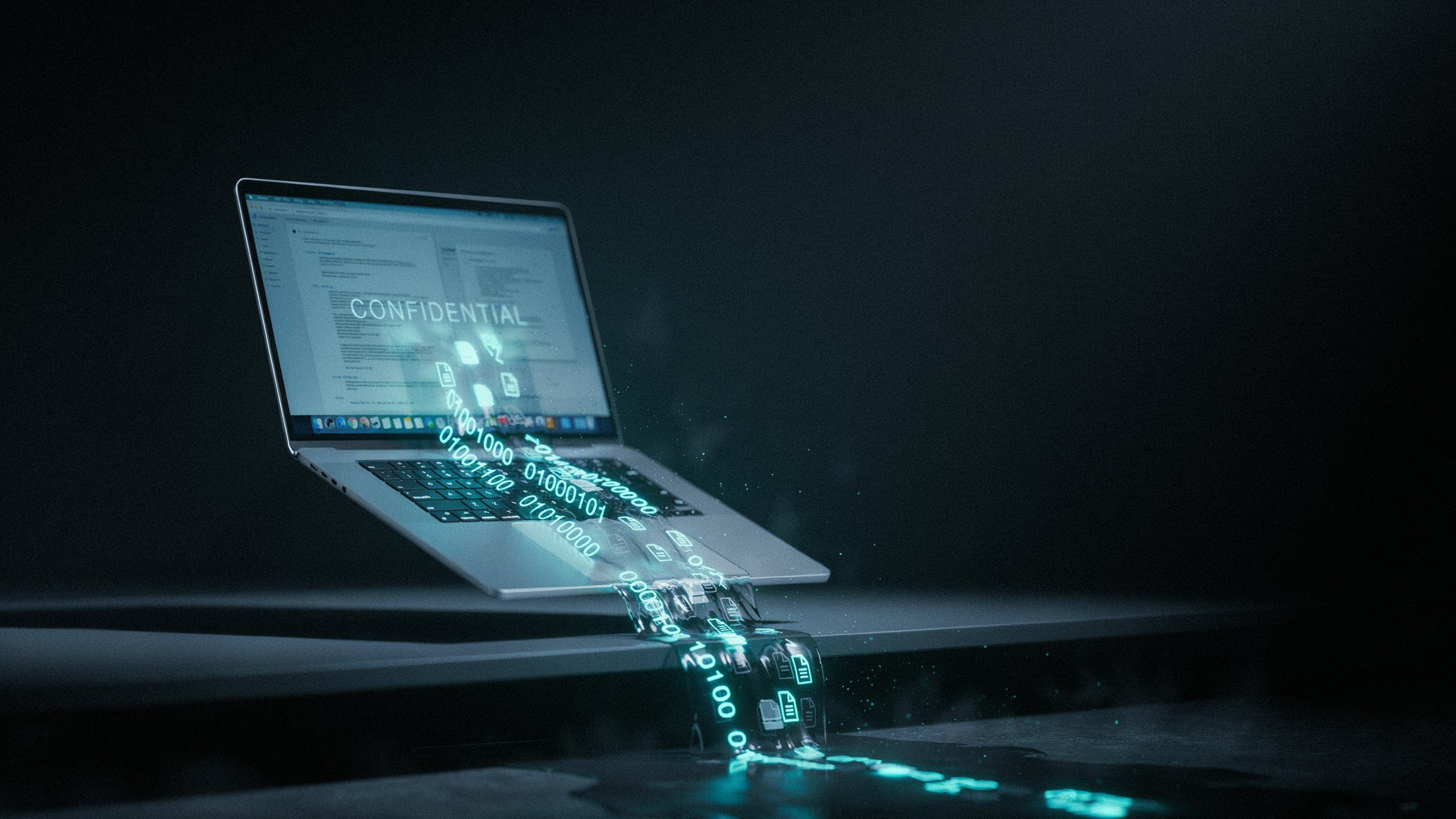
In the moment she pressed „Enter,” the company’s pricing model—one of its most valuable intellectual assets—crossed the organization’s security boundary. It no longer exists solely within internal systems governed by access controls and contractual safeguards. Regardless of whether the AI provider explicitly trains future models on this specific prompt, the information has entered an external infrastructure beyond the company’s direct control.
For many organizations, this is the beginning of an invisible leak. The issue is not malicious intent; it is architecture.
The Illusion of Privacy vs. The Reality of Sovereignty
Most users experience AI as a conversational interface. From an engineering perspective, however, every prompt initiates a data processing workflow. While providers offer „Enterprise” tiers and privacy policies, there is a critical distinction that every CEO must understand:
Data privacy policies are contractual controls. Data sovereignty is an architectural control.
A contract can reduce risk, but architecture determines whether the risk exists in the first place. When sensitive information leaves your infrastructure, you are no longer in control of your data; you are simply trusting a third party’s promise that they will handle it correctly. For high-stakes corporate intelligence, trust is a poor substitute for control.
The technical reality is that public LLMs are active data consumers. Through mechanisms like Reinforcement Learning from Human Feedback (RLHF), user interactions are often aggregated to refine model behavior. This introduces a subtle but dangerous phenomenon: informational leakage.
Unlike a traditional data breach where a file is stolen, informational leakage occurs when a model encodes statistical patterns from your data. If a model learns a unique pricing structure or a proprietary operational workflow from your input, it may unconsciously reconstruct fragments of that pattern for a competitor querying the same model weeks later. The model isn’t „leaking” a file; it is simply predicting the next statistically probable token based on a pattern it learned from you.
The Erosion of the SME „Moat”
For Small and Medium Enterprises (SMEs), this risk is disproportionate. Unlike global corporations, an SME’s competitive advantage is rarely based on scale or capital. Instead, it depends on a „moat” of specialized knowledge: unique operational processes, precise pricing strategies, and hard-won industry expertise.
These assets usually live in spreadsheets, contracts, and internal emails—exactly the materials employees submit to AI systems to save time. When a competitor replicates a unique process developed over a decade because a public AI „learned” the pattern, the financial impact is immediate and often irreversible.
This vulnerability is amplified by the rise of „Shadow AI.” This is the silent adoption of unauthorized AI tools by employees who are under pressure to increase productivity. Shadow AI is a security threat that doesn’t trigger a traditional alarm. No firewall is breached, no malware is detected, and no suspicious login occurs. Sensitive information simply flows out of the organization through legitimate user actions.
The Digital Vault: Moving Toward Private LLMs
Public AI models are exceptional tools for general tasks, but they are fundamentally unsuitable environments for proprietary corporate intelligence. The only professional mitigation for this architectural risk is the deployment of Private LLMs.
A private LLM functions as a digital vault. By hosting the model on-premise or within a dedicated, isolated private cloud, the organization ensures that sensitive data never leaves its controlled perimeter. The operational differences are absolute:
- Zero External Training
Your inputs are never used to improve a third party’s product. The model weights remain static unless you explicitly initiate a controlled, internal fine-tuning process. - Architectural Control
Data ingress and egress are governed by your own firewalls and security protocols, not a provider’s terms of service. - Secure Augmentation
The true value of a private LLM is the ability to securely connect it to internal knowledge bases (via RAG) or fine-tune it on proprietary data. You gain the analytical power of an advanced AI, but it is strictly confined to your operational context.
In this setup, AI ceases to be a potential exposure channel and becomes a secure extension of your institutional knowledge.
Executive Summary: The Bottom Line
For business owners and executives, the conclusions are straightforward.
- The risk is architectural.
Data leakage in public AI is not a result of „hacking,” but a byproduct of how these systems are designed to function. - Contracts are not enough.
Relying on a provider’s privacy policy is a contractual safeguard, not a technical one. - SMEs are the most exposed.
The loss of a proprietary „moat” can be fatal for a smaller company, whereas a large corporation can absorb the blow. - Sovereignty is the only solution.
Private LLM infrastructure is the only way to guarantee that the knowledge making your company competitive remains yours.
The strategic question is no longer whether your organization will use AI. The question is whether you will retain ownership of the intelligence that makes your business successful.
Assess Your AI Infrastructure Before Your Data Leaves the Perimeter
Most organizations have already adopted AI informally. Few have evaluated the associated risks. The longer Shadow AI remains unaddressed, the greater the probability that sensitive information will be exposed through routine business activities.
If you want to assess whether your current AI processes are secure, contact us for a consultation to analyze your AI infrastructure.